
We Speak Music
Ledher Blue will sweep you away with scuzzy effervescent slab of indie-rock ‘Fun’

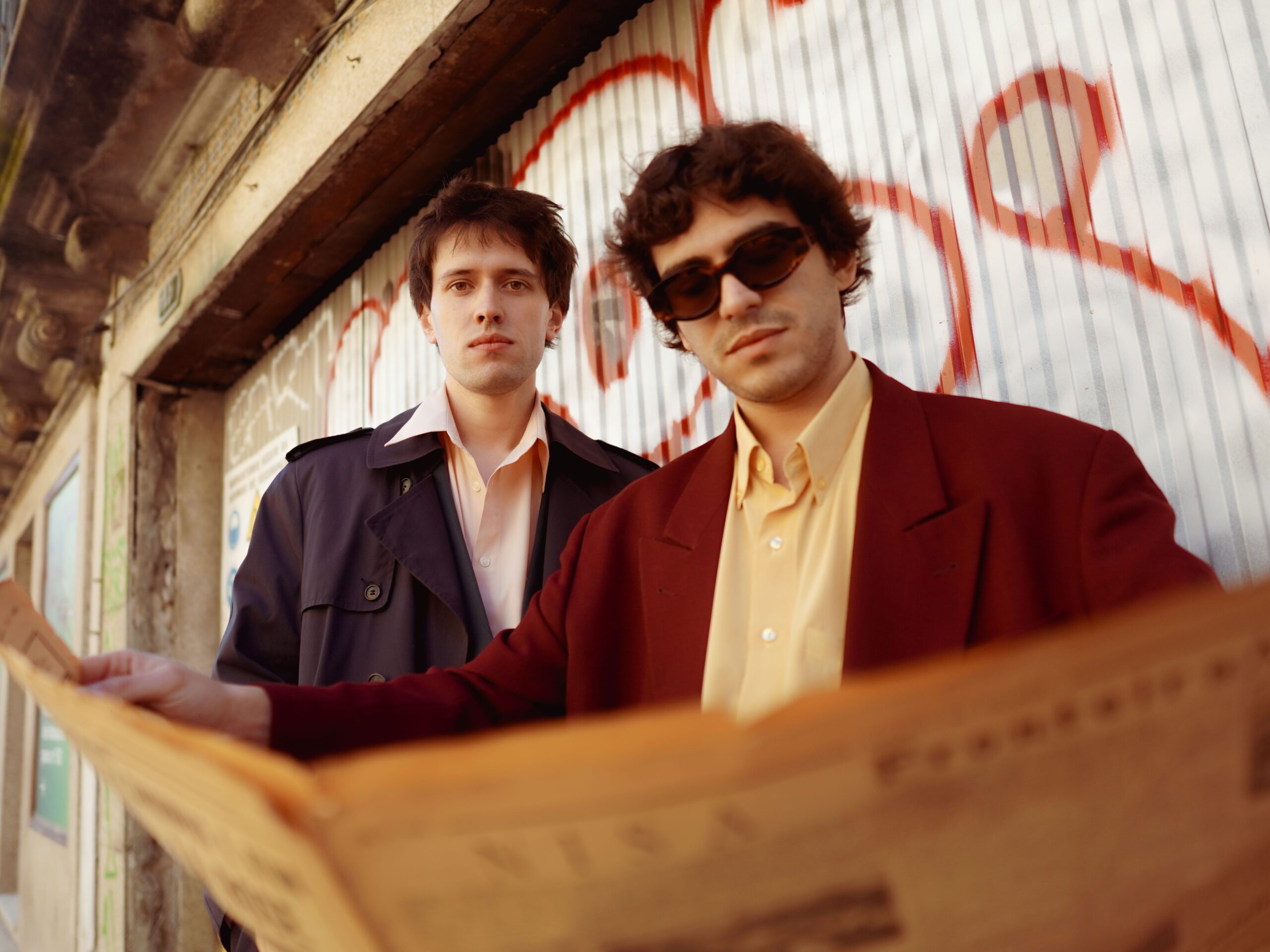
Ledher Blue’s new album ‘Fait Divers’ came from an existential crisis. Admittedly, it was shameful to accept that the most generic of internal conflicts were at hand: the “what’s the purpose of life?”s and the “why am I here?”s out of every self-help book seemed adequate, but needed to be articulated in a particular way. What was the purpose of my life until now; “Why am I here?” Zé from Ledher Blue thought as he got into Dublin.
Ledher Blue are the product of two distinctively different individuals that the waves of life comically decided to beach in a northern town of Portugal – Guimarães. The city is known for its historical meaning in the birth of Portugal, for its nasty hooligans, for its emigrant parvenus, its domestic parvenus, its humble proletariat, its shame, envy, resignation and most importantly a mystical ability of seeing the depressed times – which have long been in the region – united in empathetic jealousy, certain that betters days are coming. The club keeps losing but we’ll be champions, the people are poor but we’ll get better, everything may be bad but he will rise in a foggy sunrise.
Zé and Pedro, the pair behind Ledher Blue, encapsulated the diversity of the town in an existential way. One was always happy, one was always longing, one found a girl, the other found the one, one flourished, the other stagnated when one fell in love with the bars and was now bored the other said, “don’t gamble your life for a couple of poems”, but impressively they would always converge from different perspectives to the same idea. Certainly, one loved Illiad for Aquiles and the other for Hector, one for Vronski another for Levin, one for Grey the other for Vane, one for Liam another for Noel… what matters is that instinctively – or “zoroastrianly” – the pure meaning for their message was not what each wanted to say but the product of the pressure. This conflict was in their youth the birth of friendship and in their slope the birth of the band.
That is why one can say that one song looks happy with mournful feel, or rebellious with fearful grooves; it can be satirical in lyricism and classical in structure, it tries to be a singular unitarian message independent of the peripheral chatter. It’s alternative sometimes, post punk in the others, even poppy on some choruses, but most importantly it always feels original and unique.
Zé’s move to Dublin meant a big separation for the friends and bandmates, but most importantly brought a new perspective for their old problem. The problematic youth from Guimarães, their problematic youth, was not unique to the land. It could be observed on the Irish town. The lifeless eyes, the change dribbling in an oversized pocket, the fortuity misfortune, the keys in the bathroom, a generation sprayed with anxiety and embalmed in panic. It was paralysing. The song forcefully quieted on the lips of a dead philosopher was slivering to the bones of our time. It was as if everybody – even unconsciously – believed that regret was the only certainty of existence; that unescapable longing for the unlived life. And as the uniqueness of our situation dissolved, as our small town became countries, we found new binoculars, not only to inspect reality but most importantly our own. Transcendentally, we found our true selves, which we may have seen before, but were now so overwhelmed to the point of acceptance. As theory imprisoned and pressured reality, the only answer was King Sebastian. The individual who could look down at Narcissus smugly and was able to curse an whole nation was mystified as the long awaited saviour. Sebastian may have lead Portugal to the abyss when he disappeared in the desert but with it created a myth; the myth that he would return in a foggy morning and save us all. Hope. This hope was what united our town. What united the past generations from this existential dread and what would cure our generation. Sebastianism was the cure, it was clear.
“Not only the message was so clear it seemed to dazzle but also the universe, the habitat of each song was drawn.”, says Ledher Blue. “We felt rain during ‘Dublinesque’, the popped dark smoke from old cars for ‘Sorrows of the Amended Hearts’, the lady on the bus in ‘Craic’, the winey red out of a absolutist cape emerged on ‘Èlan’ with libertarian scarlet blues and shadowy greens, we heard the people talking in the pubs of ‘Fun’, we could distinguish the whiteness of their teeth; it stopped being a group of songs and became something else. Complete. Portugality embroiled in Irish thread. A message for all but about none, a concept for the unknown based on the past, a tale without morals.”
New single ‘Fun’ is a scuzzy effervescent slab of guitar music, that according to the band “comes from a place of hot headedness, so to speak” and is “intended for narcissistic types”. The band’s sound on the track conjures the best of 90s and early 00s indie bands, with Arctic Monkeys-esque nonchalant vocals, underpinned by a driving rhythm section that is impossible not to get swept away in, as the track’s fast paced, gritty guitars implode into a screaming mess.
Ledher Blue’s new album ‘Fait Divers’ is out now.
New Single ‘Fun’ is released 9th May.

More from We Speak Media:





Kiey is ready to take his sound beyond borders with METROMIRAGE, an ambitious third album that finds the Vietnamese independent artist bringing together alternative pop, R&B and electronic music in a polished yet deeply personal package. Across five distinct sonic and emotional dimensions of his wider artistic vision, Kiey leans into atmospheric production, intimate vocals and melodic songwriting that feels built for late-night listening. There is an appealing balance between the record’s sleek contemporary finish and its willingness to explore the messier corners of human connection. Rather than relying on explosive choruses alone, Kiey creates momentum through layered textures, subtle rhythmic shifts and melodies that gradually settle into the listener’s consciousness. His English-language approach gives the project a global pop sensibility, but the emotional core remains personal, drawing listeners into moments of romantic uncertainty, fleeting attraction and introspection. METROMIRAGE feels like the work of an artist who understands the importance of sonic identity, delivering a cohesive collection that pairs modern production with songwriting grounded in genuine feeling.
At the centre of the album’s wider appeal is ‘fun fiction’, featuring Cece Trương, a breezy, city-pop-inflected collaboration that captures the excitement of an unexpected connection. Acoustic instrumentation blends effortlessly with R&B rhythms and electro-pop details, creating a relaxed groove that feels both contemporary and nostalgic. Kie’s understated vocals provide a reflective counterpoint to Trương’s charismatic delivery, with their interplay giving the track the feeling of an intimate conversation unfolding against the lights of a bustling city. Its references to late nights in Shinjuku add a cinematic quality, transporting the listener into a world where romance feels spontaneous and full of possibility. What makes the collaboration particularly effective is its balance of distinct personalities, with neither artist overwhelming the other. Instead, their voices complement one another, allowing the song’s easygoing production and infectious melody to carry the narrative. It is a standout moment that demonstrates Kie’s knack for accessible songwriting while revealing how naturally his sound can accommodate another artist’s perspective.
Elsewhere, Kiey turns towards more introspective territory, exploring the emotional residue of encounters that linger long after the moment has passed. ‘white boy i sat next to on a plane’ pairs subdued vocals with piano-pop textures, sultry R&B influences and carefully layered harmonies, creating a song that feels intimate without becoming overly sentimental. Its unusual title invites curiosity, while the production gives the track a dreamlike quality that mirrors the fleeting nature of its subject. ‘plan thiet’ continues this more delicate approach, placing Kie’s voice at the forefront of a piano-led arrangement that allows every melodic inflection to register. These quieter moments provide an important counterbalance to the album’s more expansive pop instincts, demonstrating that Kiey does not need maximal production to make an emotional impact. Meanwhile, ‘unloveable’ leans into a fuller alt-pop sound, building its emotional tension through a broader sonic palette. Together, these tracks create a compelling portrait of an artist navigating the contradictions of intimacy, from the thrill of possibility to the uncertainty of feeling worthy of love.
One of the album’s biggest strengths is the consistency of its creative direction. Kiey’s involvement in the production process and visual development gives METROMIRAGE a unified identity, with its cool-toned aesthetic reflecting the music’s blend of melancholy, romanticism and modern electronic sheen. Each track occupies its own emotional space, yet the production maintains a clear thread throughout, allowing the album to feel cohesive without becoming repetitive. The melodies remain approachable, but there is enough detail in the arrangements to reward listeners who return for another spin. That balance is particularly important for an artist working across several genres, where the temptation to chase different sounds can sometimes dilute a project’s personality. Kiey avoids that pitfall by keeping the focus on mood and songwriting, using electronic elements to enhance the emotional atmosphere rather than overshadow it. The result is a record that feels deliberately crafted, with a clear understanding of how individual songs can contribute to a larger artistic statement.
Ultimately, METROMIRAGE establishes Kiey as a compelling independent voice within a global pop landscape that increasingly welcomes artists working beyond traditional industry centres. Its greatest strength lies in the way it brings together polished production and vulnerable songwriting, creating music that can function as both an easy melodic escape and a more intimate listening experience. ‘fun fiction’ offers an immediate entry point, but the album’s quieter moments reveal the depth of Kie’s creative instincts, particularly his ability to capture the emotional significance of encounters that might otherwise seem insignificant. There are moments when the restrained delivery leaves the listener wanting a more dramatic payoff, yet that understatement is also central to the project’s identity. Kiey is interested in atmosphere, nuance and the lingering feelings that exist between life’s defining moments, and the music reflects that perspective with clarity. With METROMIRAGE, he delivers a confident, internationally minded body of work that expands his sonic horizons while keeping his own voice firmly in focus. It is an encouraging step forward for an artist whose ambition is matched by a clear sense of creative purpose.
More from We Speak Media:
-

 We Speak Jazz19 hours ago
Toronto Jazz Singer Ori Dagan Announces First Live Album ‘Live in the Market’ for October 23 Release
-

 We Speak Boxing2 days ago
Most Valuable Promotions Announces MVPW-07: Four World Title Fights Headlined by Baumgardner vs. Turhan in Arlington
-

 We Speak Dining & Drinks3 days ago
Off The Rails Opens in Boston, Bringing Nashville-Inspired Dining, Live Music and High-Energy Entertainment Downtown
-

 We Speak Comedy2 days ago
Nate Bargatze Plays Rexburg Tomorrow, Then Settles Into Las Vegas on the Record-Breaking Big Dumb Eyes Tour