
We Speak Fashion
Teyana Taylor Turns the Trench Coat Into Couture at the BAFTAs

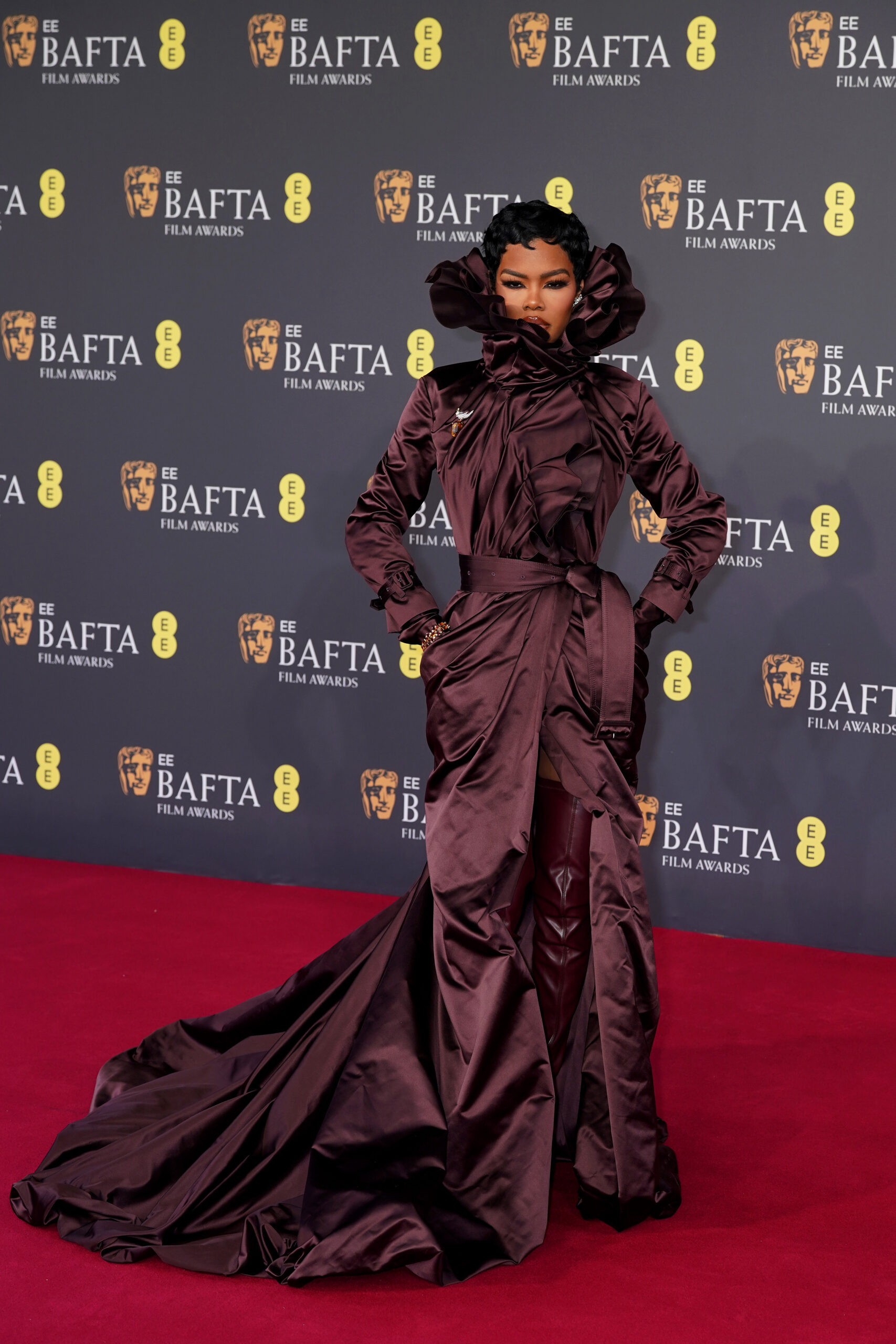
Teyana Taylor brought a British icon back to its home carpet — rebuilt as couture. At the 79th EE BAFTA Film Awards, held Sunday, February 22 at the Royal Festival Hall in London and hosted by Alan Cumming, Taylor arrived as a Supporting Actress nominee for One Battle After Another, the film that led the night with 14 nominations. Her choice for Britain’s biggest film night was a custom Burberry gown under creative director Daniel Lee, and it became one of the evening’s most discussed looks.
The gown took the house’s signature trench coat as its blueprint. Cut in plum-colored silk duchesse, it carried the trench’s buckle detailing and a cinched waist, rising into a dramatic ruffled funnel neck that wrapped elegantly from her shoulders upward. Taylor finished the look with Tiffany & Co. jewels: a Bird on a Rock brooch set with a citrine of over 50 carats, diamond earrings, an archival bracelet and gemstone rings — hardware answering hardware, the jewels echoing the gown’s buckled construction.
The look landed because it translated a British house’s codes into red-carpet couture on the one night built to celebrate them. It also extended a formidable awards-season style run: Taylor had already won Best Supporting Actress at the Golden Globes for the same film, in custom Schiaparelli. Harper’s Bazaar Arabia and The Zoe Report both placed the Burberry on their BAFTA best-dressed lists, in a strong field that included Emma Stone in a custom halter-neck Louis Vuitton gown with a teardrop cutout and Kate Hudson in off-the-shoulder red Prada.
Every great BAFTA carpet needs a look that could only have happened in London. In 2026 it was this one: the most famous coat in British fashion, reimagined as a gown, worn by the nominee of the night’s most-nominated film. The day-after coverage kept returning to the same construction — a couture dress built entirely from the vocabulary of a raincoat — and on a night devoted to British film, no translation of a house code was more complete.
 L’Oréal Powers Past the Beauty Market: €35.33 Billion in Nine Months as Salon and Derm Brands Lead
 From a Maine Classroom to the Runway: Solange Omon Wins Victoria’s Secret’s Angel Search and an IMG Models Contract
 Unfiltered Wisdom Launches in Los Angeles With Apparel Made for Gen X Women
 EKOUAER Marks 11 Years With Global Launch of Its Premium Collection
 Smith-Njigba, Wilson Lead Seahawks Past Chiefs 20-3 on Sunday Night, Handing Kansas City Its First Loss
 Six Straight: No. 12 Kentucky Erases Early Hole to Beat Vanderbilt 34-17
 Texas Holds On This Time: Longhorns Survive Ole Miss Comeback 34-27
 Orsan at the Buzzer: South Carolina Shocks No. 11 Tennessee 27-24 in Columbia



We Speak Fashion
L’Oréal Powers Past the Beauty Market: €35.33 Billion in Nine Months as Salon and Derm Brands Lead
The world’s largest beauty company is growing faster than the market it leads. L’Oréal reported sales of €35.33 billion for the first nine months of 2026, up 6.9% like-for-like and 7.7% as reported, in a statement released on October 22. Third-quarter sales reached €11.56 billion, up 7.2% like-for-like.
CEO Nicolas Hieronimus called it “an exceptional third quarter,” saying the global beauty market “once again proved its resilience” and that L’Oréal “continued to significantly outpace it” — company commentary put the wider market’s growth at roughly 5% for the quarter.
The quarter’s heavy lifting came from the group’s two professional-facing divisions. Professional Products — home to Kérastase, Redken and L’Oréal Professionnel — sold €1,469.1 million in Q3, up 12.1% like-for-like, while Dermatological Beauty (La Roche-Posay, CeraVe, SkinCeuticals) sold €1,871.6 million, up 12.2%. L’Oréal Luxe added €4,176.6 million (+6.4%) and Consumer Products €4,044.3 million (+4.3%), as fragrances and haircare drove growth, skincare continued to accelerate, and e-commerce sales grew around 17% — well ahead of the online beauty market.
The brand highlights told the same story. Kérastase grew double-digit, powered by Gloss Absolu, Genesis and Chronologiste; La Roche-Posay launched Mela B3 Double-Dose and Anthelios UV Air; Yves Saint Laurent’s Libre and MYSLF fragrances grew double-digit; and the newly acquired fragrance house Creed performed strongly.
Regionally, SAPMENA-SSA was the standout at +19.2% like-for-like, followed by Europe at +9.9% and North Asia at +7.8%; North America grew 2.2% (5.6% adjusted), and Latin America was the only region to decline, down 1.0%. During the period L’Oréal also closed its acquisition of a majority stake in Innovist, a digital-first Indian personal care house of brands — a results statement that underlines a simple point: at €35 billion in nine months, L’Oréal is not just leading the beauty business, it is widening the gap.
From a Maine Classroom to the Runway: Solange Omon Wins Victoria’s Secret’s Angel Search and an IMG Models ContractUnfiltered Wisdom Launches in Los Angeles With Apparel Made for Gen X WomenEKOUAER Marks 11 Years With Global Launch of Its Premium Collection CÈGLÈ Launches in London With a Return to Timeless EleganceSmith-Njigba, Wilson Lead Seahawks Past Chiefs 20-3 on Sunday Night, Handing Kansas City Its First LossSix Straight: No. 12 Kentucky Erases Early Hole to Beat Vanderbilt 34-17Texas Holds On This Time: Longhorns Survive Ole Miss Comeback 34-27Orsan at the Buzzer: South Carolina Shocks No. 11 Tennessee 27-24 in Columbia
-

 We Speak Jazz3 days ago
Toronto Jazz Singer Ori Dagan Announces First Live Album ‘Live in the Market’ for October 23 Release
-

 We Speak Comedy4 days ago
Nate Bargatze Plays Rexburg Tomorrow, Then Settles Into Las Vegas on the Record-Breaking Big Dumb Eyes Tour
-

 WE Speak MMA4 days ago
UFC 334: Gane vs. Hokit, Harrison vs. Nunes Title Fights Set for November 14 at Madison Square Garden
-

 We Speak Movies2 days ago
AFI Fest 2026 Opens in Hollywood: Laika’s ‘Wildwood’ Kicks Off the Festival’s 40th Edition