We Speak Authors
Howard Bloom – The Case of the Sexual Cosmos: Everything You Know About Nature Is Wrong – New Book Coming in 2025


The Case of the Sexual Cosmos is the latest book of paradigm-challenges from Howard Bloom, the man Britain’s Channel 4 TV calls the Einstein, Newton, Darwin and Freud of the 21st century. And the Case of the Sexual Cosmos: Everything You Know About Nature is Wrong just may turn your existing view of yourself and of the universe you live in upside down and inside out.
The Case of the Sexual Cosmos says that we’ve got nature all wrong. The Sexual Cosmos tells the tale of the universe from the big bang to what’s going on in your brain as you read this sentence, unmasking a startling face of the evolutionary saga. Nature is green in tooth and claw.

In The Case of the Sexual Cosmos’ meticulously-researched telling of the evolutionary story, life does not live in harmony with nature. Far from it. Life does not take nature lying down. Life is obstreperous. Life is uppity. Life is impertinent. Life is not a mere survivor. Life is a doomrider and a catastrophe tamer. Life takes nature apart and puts her back together in whole new ways. Nature uses life to reinvent herself.
What’s more, The Case of the Sexual Cosmos proposes a scientific paradigm shift. The book argues that it’s time to toss out one of science’s most cherished concepts, The Second Law of Thermodynamics. The law that all things fall apart. The Case of the Sexual Cosmos proposes that the Second Law be replaced by The First Law of Flamboyance. The law that things do not just fall apart. They fall together.
And The Case of the Sexual Cosmos shows what this means to your life and mine.
MacArthur Genius Award winner Richard Foreman says The Case Of The Sexual Cosmos is “a massive achievement. Wow!” BBC-TV producer of seven science series including Connections, James Burke, calls The Case of the Sexual Cosmos “a triumph…full of surprises, unexpected connections, [and] complexifying outcomes ” Fellow of the British Interplanetary Society Gregory Matloff calls The Case of the Sexual Cosmos “a masterwork.”
Conrad Labandeira of the Smithsonian Institution says that The Case of the Sexual Cosmos is “enjoyable and compelling.” And Harvard’s Ellen Langer says that The Case of the Sexual Cosmos is “a fascinating read…….[Bloom] argues that we are not savaging the earth as some would have it, but instead are growing the cosmos.”

Concludes novelist Helen Zuman, The Case of the Sexual Cosmos pulls “us out of Greta Thunberg’s self-hate machine” and shows that, “The true tragedy is not war or climate catastrophe. It’s rejecting the exuberant flamboyance of exactly who we are.”
More About Howard Bloom:
Howard Bloom of the Howard Bloom Institute has been called the Einstein, Newton, Darwin, and Freud of the 21st century by Britain’s Channel 4 TV. One of his eight books–Global Brain—was the subject of a symposium thrown by the Office of the Secretary of Defense including representatives from the State Department, the Energy Department, DARPA, IBM, and MIT. His work has been published in The Washington Post, The Wall Street Journal, Wired, Psychology Today, and the Scientific American. A former Visiting Scholar at New York University’s Graduate Psychology Department, a former Core Faculty member at the Graduate Institute in Meriden, Connecticut, and the current Kepler Space University Professor of Practice, Bloom has been published in journals or has spoken at scholarly conferences in twelve different scientific fields, from quantum physics and cosmology to neuroscience, information theory, and biopolitics. He calls this multi-disciplinary approach “Omnology.” Concludes Joseph Chilton Pearce, author of Evolution’s End and The Crack in the Cosmic Egg, “I have finished Howard Bloom’s [first two] books, The Lucifer Principle and Global Brain, in that order, and am seriously awed, near overwhelmed by the magnitude of what he has done. I never expected to see, in any form, from any sector, such an accomplishment. I doubt there is a stronger intellect than Bloom’s on the planet.”



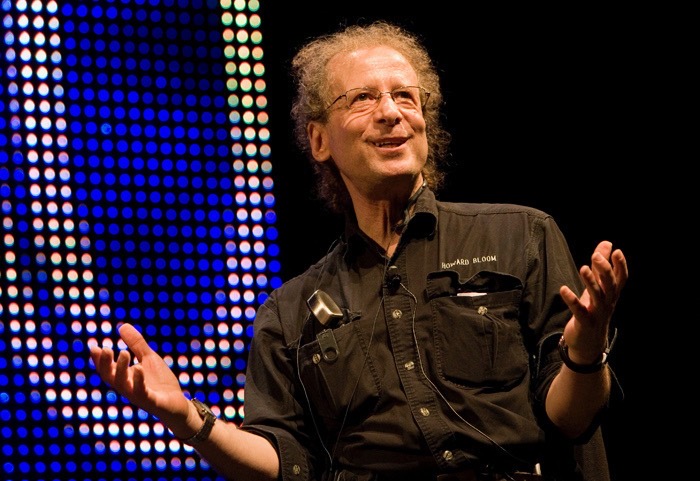
The legendary thinker, author and former music-industry powerhouse argues that sex, excess, invention and even waste may reveal something extraordinary about the universe—and about us
Howard Bloom has never been particularly interested in small questions.
Across a career that has moved from science to rock and roll, psychology, evolutionary theory, history and cosmology, Bloom has repeatedly gone after subjects so enormous that most writers would hesitate to touch them. His books have explored everything from the forces behind human conflict to collective intelligence, capitalism and the creative machinery of the universe itself.
Now Bloom may have delivered his biggest provocation yet.

The Case of the Sexual Cosmos: Everything You Know About Nature Is Wrong is a sprawling 682-page attempt to reconsider some of our most comfortable assumptions about nature—and to ask whether life is driven by something far more extravagant than simple survival. Published by World Philosophy & Religion Press, the book brings together biology, physics, history, sexuality, technology and philosophy in a characteristically Bloomian attempt to find connections where conventional academic disciplines tend to see boundaries.
And that deliberately confrontational subtitle—Everything You Know About Nature Is Wrong—isn’t there merely to sell books.
Bloom means it.
What If Nature Isn’t What We’ve Been Told?
One of the central targets of The Case of the Sexual Cosmos is the popular image of nature as inherently balanced, economical and harmonious—a pristine system that human beings entered and subsequently disrupted.
Bloom presents something considerably messier.
In his telling, life on Earth has always existed amid catastrophe, upheaval and radical environmental change. Yet rather than simply enduring hostile conditions, living systems repeatedly found ways to exploit them.
Life didn’t merely survive adversity. It turned adversity into opportunity.
Bloom points toward one of the most dramatic examples in Earth’s history: oxygen. What became indispensable to complex life emerged from biological processes that profoundly altered the planet’s atmosphere. His larger argument is that life repeatedly transforms its surroundings rather than politely adapting to an unchanging natural order.
That distinction matters because Bloom wants readers to reconsider the relationship between humanity and nature.
Perhaps transformation isn’t an aberration.
Perhaps transformation is what life does.

Then Bloom Brings Sex Into the Argument
The title may sound intentionally provocative, but sexuality isn’t being used merely as a metaphor.
For Bloom, sexual reproduction provides evidence of one of nature’s strangest characteristics: its extraordinary willingness to expend resources on abundance, competition, display and experimentation.
Nature can be spectacularly wasteful.
Consider reproduction itself. Organisms frequently produce vastly more reproductive material than will ever result in offspring. Plants pour resources into flowers, colors, scents, seeds and pollen. Animals develop elaborate displays, enormous antlers, brilliant plumage and complicated courtship rituals.
If nature’s overriding commandment were simply efficiency, much of the living world would seem almost absurd.
Bloom sees something else operating.
Flamboyance.
Experimentation.
Competition.
Excess.
And ultimately, innovation.
Sexual selection can reward characteristics that appear extravagant precisely because they communicate something valuable to potential mates. What looks wasteful when viewed through one lens may become enormously consequential when viewed through another.
Bloom takes that observation and pushes it much further.
What if the universe’s story isn’t simply one of things running down?
What if it is also a story of things building up?
Bloom Versus Entropy
That brings The Case of the Sexual Cosmos into much more controversial territory.
Bloom challenges what he sees as an overly dominant cultural interpretation of entropy and the Second Law of Thermodynamics—the idea that the universe’s grand narrative is ultimately one of increasing disorder.
He doesn’t simply argue that thermodynamics should be discarded. Rather, his argument is that focusing exclusively on entropy leaves something astonishing unexplained: the universe has also produced stars, planets, chemistry, cells, forests, brains, civilizations, Shakespeare, skyscrapers, computers and spacecraft.
Complexity happened.
And it keeps happening.
Bloom’s question is essentially impossible to ignore once he frames it this way: if disorder is the whole story, where did all this extraordinary organization come from?
His answer reaches across billions of years.
Life recruits matter into increasingly complicated arrangements. Organisms reshape environments. Environments create new evolutionary pressures. Those pressures generate new adaptations, which generate new possibilities.
Bloom describes life as something far more aggressive and inventive than a passenger riding aboard planet Earth.
It is an active participant in planetary transformation.
From Michael Jackson and Prince to the Cosmos
Bloom’s intellectual journey is nearly as unusual as his theories.
Long before he became known for books such as The Lucifer Principle, Global Brain and The God Problem, Bloom built a formidable career in the music business. Simon & Schuster describes him as a legendary publicist who worked with artists including Prince, Michael Jackson, Billy Joel and Styx.
It’s a strange résumé for a man writing about cosmology and evolutionary systems—until you look more closely.
Bloom has spent much of his life studying how things become bigger than themselves.
A musician becomes a cultural phenomenon. Individuals form groups. Groups create movements. Biological organisms create ecosystems. Human beings create civilizations. Matter somehow organizes itself into systems capable of looking back at the universe and asking why any of it exists.
That fascination runs through his earlier work.
Global Brain examined collective behavior and intelligence. The Lucifer Principle explored the biological and social forces behind history and group conflict. The God Problem confronted the question of how an apparently godless universe can generate extraordinary novelty and complexity.
The Case of the Sexual Cosmos feels like those intellectual obsessions expanding until they encompass virtually everything.

Humanity Isn’t Outside Nature
Perhaps the book’s most provocative implication concerns us.
Modern culture often describes humanity as though we are somehow separate from nature: nature creates forests; humans create cities. Nature produces birds’ nests; humans manufacture airplanes.
Bloom questions that distinction.
If human beings emerged through natural processes, then human creativity emerged from nature too.
Our technologies didn’t arrive from another universe.
Brains produced them.
And nature produced brains.
That leads Bloom toward an argument likely to delight some readers and infuriate others: human technological ambition may not necessarily represent a betrayal of nature. It may represent another stage in life’s longstanding tendency to transform its environment and expand what living systems can accomplish.
Bloom ultimately extends that argument beyond Earth itself, imagining humanity helping life move outward into the solar system and potentially beyond. His vision isn’t one of humans retreating from existence but of life continuing its astonishing expansion.
It’s an audacious proposition.
But audacity is basically Bloom’s native language.
A Book Designed to Start Arguments
Not everyone will agree with Howard Bloom’s conclusions.
That almost seems beside the point.
Bloom isn’t writing the intellectual equivalent of comfort food. He wants readers arguing with him, questioning assumptions and reconsidering ideas they may have accepted so completely that they no longer realize they’re assumptions.
The response from prominent readers reflects the book’s unusual scope. Harvard psychology professor Ellen Langer called it “a fascinating read,” while Smithsonian research scientist Conrad Labandeira described the book as “engaging, enjoyable, and compelling.” Theater innovator and MacArthur Fellow Richard Foreman called it a “massive achievement.”
Those reactions make sense because The Case of the Sexual Cosmos isn’t really about sex alone.
Nor is it simply about evolution, entropy, climate, technology or cosmology.
It’s about the story we tell ourselves about existence.
Are human beings an ecological mistake in a universe slowly collapsing toward disorder?
Or are we part of something ancient, restless and astonishing—a process that has spent billions of years turning dead matter into living systems, living systems into consciousness, and consciousness into something capable of reaching beyond the planet where it began?
Howard Bloom knows exactly which possibility he finds more interesting.
And with The Case of the Sexual Cosmos, he’s inviting the rest of us to argue about it.
-

 We Speak Music1 week ago
National Gospel Recording Artist Ellen Hayes Announces the Release of Her Farewell Album, Behind My Eyes
-
We Speak Music1 week ago
Mel D makes bittersweetness glow with magnetic new single ‘ORANGE’
-

 We Speak Music1 week ago
Kazimi Shines In New Single ‘Errant Nodes’
-

 We Speak Music1 week ago
Karabo Unleashes New Single ‘Only 4 U’