
We Speak Authors
Sanford K. Sanford, Son of Isabel Sanford, Star of “The Jeffersons”, Guests On Harvey Brownstone Interviews

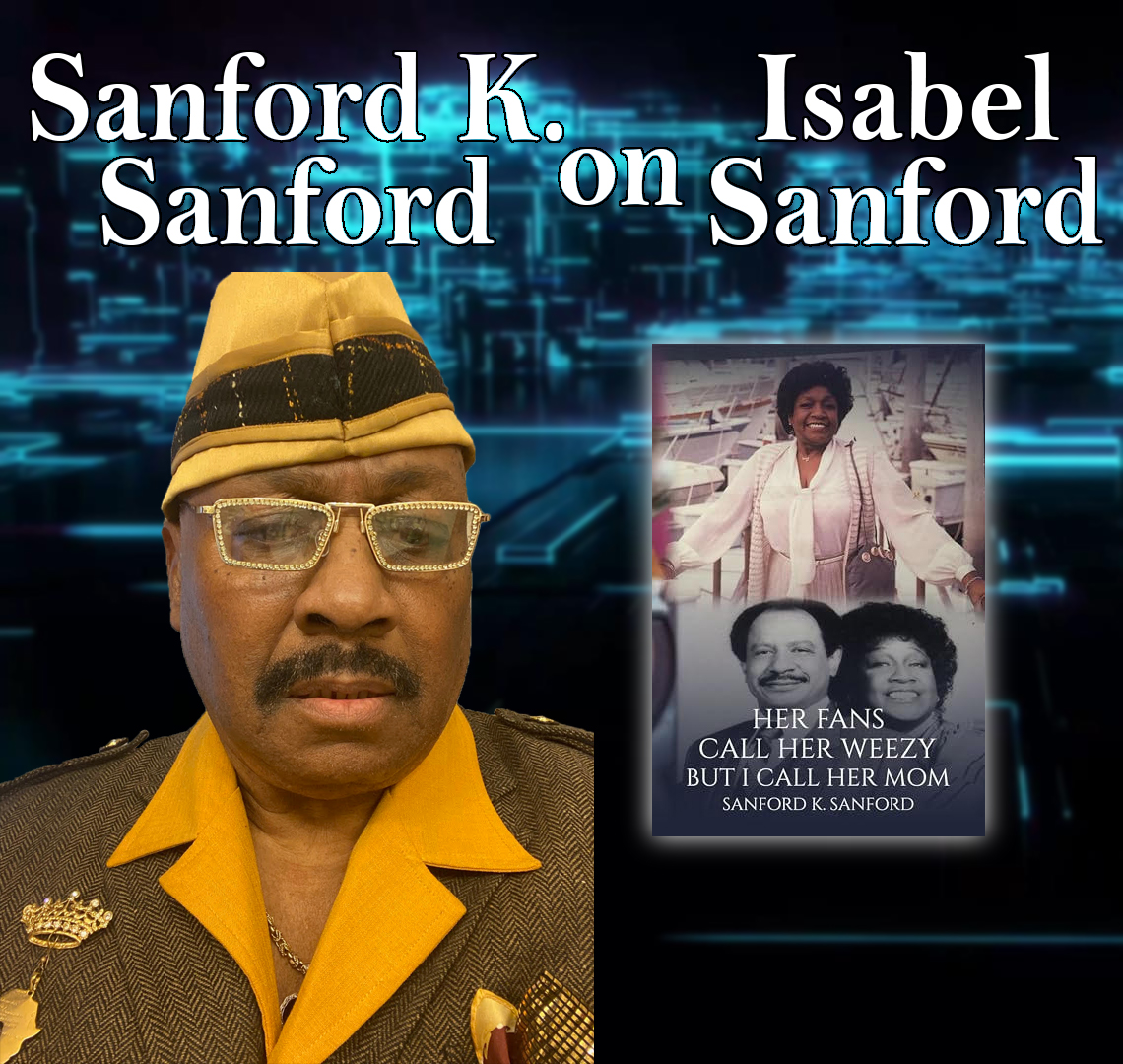
Harvey Brownstone conducts an in-depth Interview with Sanford K. Sanford, Son of Isabel Sanford, Star of “The Jeffersons”.
Sanford K. Sanford is the son of one of the most popular and beloved stars in the history of television, Isabel Sanford, whose portrayal of Louise Jefferson – or “Weezy”, as we came to know her – first on “All in the Family”, and then for 11 seasons on “The Jeffersons”, made her a household name.

After a distinguished career on the stage, she landed the role of “Tillie” in the classic 1967 movie, “Guess Who’s Coming to Dinner”, opposite Katherine Hepburn, Spencer Tracy and Sydney Poitier. From there, she was cast as Louise Jefferson, next door neighbor to “the Bunkers” on the groundbreaking TV show, “All in the Family”. And THAT led to the incredibly successful spinoff, “The Jeffersons”.
Isabel Sanford received 7 Emmy Award nominations, and WON an Emmy in 1981, making her the first and still the only African American woman to win an Emmy Award for Outstanding Lead Actress in a Comedy Series. She was also nominated for 5 Golden Globe Awards. She won TWO NAACP Image Awards, and in 1981 she won a Genie Award from the American Women in Radio and Television Association. And in 1985 she received an Honorary Doctorate from Emerson College. She has a star on the Hollywood Walk of Fame. And in 2004, she and her co-star Sherman Hemsley, won a TV Land Award for Favorite Cantankerous Couple.
Sanford K. Sanford has written a wonderful, heartwarming book, entited, “Her Fans Call Her Weezy, But I Call Her Mom”, in which he shares many poignant and life-altering moments with his beloved Mama, and allows the reader to get to know the real person behind the beloved actress – a courageous single mother of 3 children who, despite many challenges in her life, showed remarkable determination and remained focused on becoming a successful actress. Our guest has had a successful music career as a percussionist, and he’s worked with Quincy Jones, Marvin Gaye, Johnny Guitar Watson, Bobby Womack, Cuba Gooding Sr. and The Main Ingredient.

Harvey Brownstone is a retired judge of the Ontario Court of Justice and was the first openly gay judge in Canada. He is also the bestselling author of “Tug of War: A Judge’s Verdict on Separation, Custody Battles and the Bitter Realities of Family Court” and hosted “Family Matters with Justice Harvey Brownstone,” a television talk show on matters involving the family justice system.
After a distinguished legal career, Harvey was appointed a judge at the age of 38 in 1995. He has presided in family and criminal courts. He has been a trailblazer in several ways. He was the first openly gay judge in Canada. He was the first sitting judge in the world to write a national best seller and to host a TV talk show.
Harvey has been a role model and icon in the LGBTQ community. When same-sex marriage was legalized in Canada in 2003, he was the only judge to make himself publicly available to officiate at weddings for lesbian and gay couples travelling to Toronto from all over the world to get married. In 2007, he officiated at the wedding of Edith Windsor and Thea Spyer, the American couple whose marriage triggered the 2013 United States Supreme Court decision overturning the definition of “spouse” in the federal Defense of Marriage Act.

In February 2021, Harvey launched his online talk show “Harvey Brownstone Interviews” on his own YouTube channel. He saw this as an interesting hobby. Within several months, the show attracted hundreds of thousands – and then eventually, millions – of viewers. Because of the overwhelming success of the show, Harvey decided to retire from the judiciary on December 31, 2021 after having presided as a full-time judge for 26 1/2 years. Free from the constraints imposed upon judges regarding the expression of opinions and the endorsement of private enterprise, Harvey now happily devotes his full-time attention to hosting “Harvey Brownstone Interviews” as a regular member of the public – albeit one with a rather illustrious and unique career history.
Watch Sanford K. Sanford on Harvey Brownstone Interviews on Youtube here:
The official website for Harvey Brownstone Interviews may be found at https://www.harveybrownstoneinterviews.com
Get “The Talk Show Blend” – Coffee For The Modern Day Trailblazer! By Harvey Brownstone from Breakfast At Dominique’s available at https://www.HollywoodBlends.com
For more information about Harvey Brownstone, here’s his Wikipedia page:




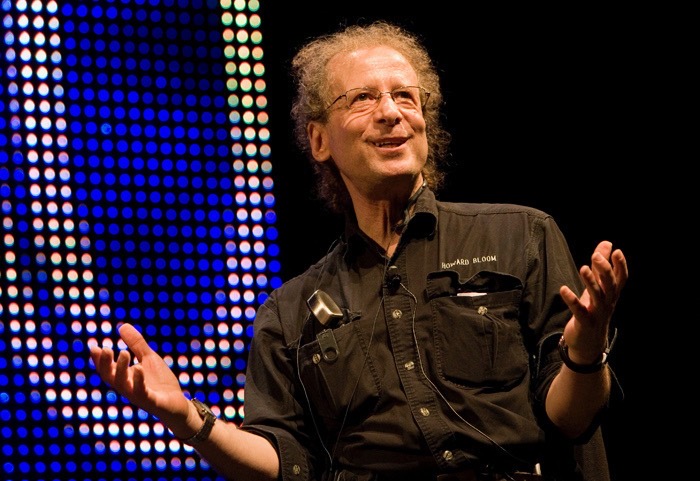
The legendary thinker, author and former music-industry powerhouse argues that sex, excess, invention and even waste may reveal something extraordinary about the universe—and about us
Howard Bloom has never been particularly interested in small questions.
Across a career that has moved from science to rock and roll, psychology, evolutionary theory, history and cosmology, Bloom has repeatedly gone after subjects so enormous that most writers would hesitate to touch them. His books have explored everything from the forces behind human conflict to collective intelligence, capitalism and the creative machinery of the universe itself.
Now Bloom may have delivered his biggest provocation yet.

The Case of the Sexual Cosmos: Everything You Know About Nature Is Wrong is a sprawling 682-page attempt to reconsider some of our most comfortable assumptions about nature—and to ask whether life is driven by something far more extravagant than simple survival. Published by World Philosophy & Religion Press, the book brings together biology, physics, history, sexuality, technology and philosophy in a characteristically Bloomian attempt to find connections where conventional academic disciplines tend to see boundaries.
And that deliberately confrontational subtitle—Everything You Know About Nature Is Wrong—isn’t there merely to sell books.
Bloom means it.
What If Nature Isn’t What We’ve Been Told?
One of the central targets of The Case of the Sexual Cosmos is the popular image of nature as inherently balanced, economical and harmonious—a pristine system that human beings entered and subsequently disrupted.
Bloom presents something considerably messier.
In his telling, life on Earth has always existed amid catastrophe, upheaval and radical environmental change. Yet rather than simply enduring hostile conditions, living systems repeatedly found ways to exploit them.
Life didn’t merely survive adversity. It turned adversity into opportunity.
Bloom points toward one of the most dramatic examples in Earth’s history: oxygen. What became indispensable to complex life emerged from biological processes that profoundly altered the planet’s atmosphere. His larger argument is that life repeatedly transforms its surroundings rather than politely adapting to an unchanging natural order.
That distinction matters because Bloom wants readers to reconsider the relationship between humanity and nature.
Perhaps transformation isn’t an aberration.
Perhaps transformation is what life does.

Then Bloom Brings Sex Into the Argument
The title may sound intentionally provocative, but sexuality isn’t being used merely as a metaphor.
For Bloom, sexual reproduction provides evidence of one of nature’s strangest characteristics: its extraordinary willingness to expend resources on abundance, competition, display and experimentation.
Nature can be spectacularly wasteful.
Consider reproduction itself. Organisms frequently produce vastly more reproductive material than will ever result in offspring. Plants pour resources into flowers, colors, scents, seeds and pollen. Animals develop elaborate displays, enormous antlers, brilliant plumage and complicated courtship rituals.
If nature’s overriding commandment were simply efficiency, much of the living world would seem almost absurd.
Bloom sees something else operating.
Flamboyance.
Experimentation.
Competition.
Excess.
And ultimately, innovation.
Sexual selection can reward characteristics that appear extravagant precisely because they communicate something valuable to potential mates. What looks wasteful when viewed through one lens may become enormously consequential when viewed through another.
Bloom takes that observation and pushes it much further.
What if the universe’s story isn’t simply one of things running down?
What if it is also a story of things building up?
Bloom Versus Entropy
That brings The Case of the Sexual Cosmos into much more controversial territory.
Bloom challenges what he sees as an overly dominant cultural interpretation of entropy and the Second Law of Thermodynamics—the idea that the universe’s grand narrative is ultimately one of increasing disorder.
He doesn’t simply argue that thermodynamics should be discarded. Rather, his argument is that focusing exclusively on entropy leaves something astonishing unexplained: the universe has also produced stars, planets, chemistry, cells, forests, brains, civilizations, Shakespeare, skyscrapers, computers and spacecraft.
Complexity happened.
And it keeps happening.
Bloom’s question is essentially impossible to ignore once he frames it this way: if disorder is the whole story, where did all this extraordinary organization come from?
His answer reaches across billions of years.
Life recruits matter into increasingly complicated arrangements. Organisms reshape environments. Environments create new evolutionary pressures. Those pressures generate new adaptations, which generate new possibilities.
Bloom describes life as something far more aggressive and inventive than a passenger riding aboard planet Earth.
It is an active participant in planetary transformation.
From Michael Jackson and Prince to the Cosmos
Bloom’s intellectual journey is nearly as unusual as his theories.
Long before he became known for books such as The Lucifer Principle, Global Brain and The God Problem, Bloom built a formidable career in the music business. Simon & Schuster describes him as a legendary publicist who worked with artists including Prince, Michael Jackson, Billy Joel and Styx.
It’s a strange résumé for a man writing about cosmology and evolutionary systems—until you look more closely.
Bloom has spent much of his life studying how things become bigger than themselves.
A musician becomes a cultural phenomenon. Individuals form groups. Groups create movements. Biological organisms create ecosystems. Human beings create civilizations. Matter somehow organizes itself into systems capable of looking back at the universe and asking why any of it exists.
That fascination runs through his earlier work.
Global Brain examined collective behavior and intelligence. The Lucifer Principle explored the biological and social forces behind history and group conflict. The God Problem confronted the question of how an apparently godless universe can generate extraordinary novelty and complexity.
The Case of the Sexual Cosmos feels like those intellectual obsessions expanding until they encompass virtually everything.

Humanity Isn’t Outside Nature
Perhaps the book’s most provocative implication concerns us.
Modern culture often describes humanity as though we are somehow separate from nature: nature creates forests; humans create cities. Nature produces birds’ nests; humans manufacture airplanes.
Bloom questions that distinction.
If human beings emerged through natural processes, then human creativity emerged from nature too.
Our technologies didn’t arrive from another universe.
Brains produced them.
And nature produced brains.
That leads Bloom toward an argument likely to delight some readers and infuriate others: human technological ambition may not necessarily represent a betrayal of nature. It may represent another stage in life’s longstanding tendency to transform its environment and expand what living systems can accomplish.
Bloom ultimately extends that argument beyond Earth itself, imagining humanity helping life move outward into the solar system and potentially beyond. His vision isn’t one of humans retreating from existence but of life continuing its astonishing expansion.
It’s an audacious proposition.
But audacity is basically Bloom’s native language.
A Book Designed to Start Arguments
Not everyone will agree with Howard Bloom’s conclusions.
That almost seems beside the point.
Bloom isn’t writing the intellectual equivalent of comfort food. He wants readers arguing with him, questioning assumptions and reconsidering ideas they may have accepted so completely that they no longer realize they’re assumptions.
The response from prominent readers reflects the book’s unusual scope. Harvard psychology professor Ellen Langer called it “a fascinating read,” while Smithsonian research scientist Conrad Labandeira described the book as “engaging, enjoyable, and compelling.” Theater innovator and MacArthur Fellow Richard Foreman called it a “massive achievement.”
Those reactions make sense because The Case of the Sexual Cosmos isn’t really about sex alone.
Nor is it simply about evolution, entropy, climate, technology or cosmology.
It’s about the story we tell ourselves about existence.
Are human beings an ecological mistake in a universe slowly collapsing toward disorder?
Or are we part of something ancient, restless and astonishing—a process that has spent billions of years turning dead matter into living systems, living systems into consciousness, and consciousness into something capable of reaching beyond the planet where it began?
Howard Bloom knows exactly which possibility he finds more interesting.
And with The Case of the Sexual Cosmos, he’s inviting the rest of us to argue about it.
-

 We Speak Music1 week ago
Moon Rocket Finds the Space Between Soul and Dancefloor on ‘Just Us Alone’
-

 We Speak Music1 week ago
The Songs of Butler & Cupples Share New Single ‘Therapy’
-

 We Speak Hip-Hop1 week ago
Hieroglyphics drop new LP & video
-

 We Speak Music1 week ago
Slay Raché Shines In New Single “You Make Me Wanna Dance”