
We Speak Entertainment
MULTI-PLATINUM SELLING HILLSONG WORSHIP WINS FIRST-EVER GRAMMY® AWARD FOR POWERHO– USE SONG “WHAT A BEAUTIFUL NAME”

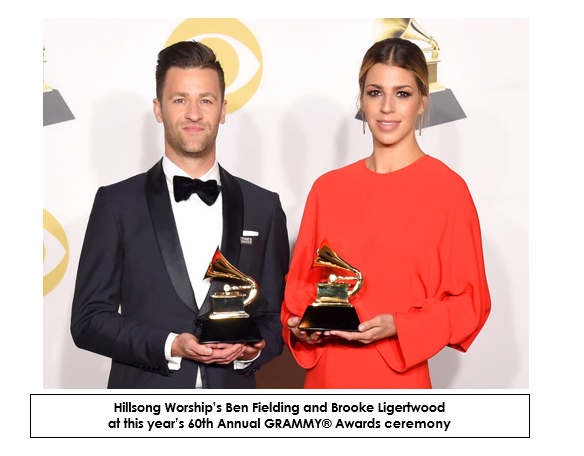
Hillsong Worship won its first GRAMMY® Award for Best Contemporary Christian Music Performance/Song for their genre-smashing single, “What A Beautiful Name” that continues to be the fastest growing song in modern church history (112 million views on YouTube). The category, created in 2015, recognizes both songwriters and performers. “What A Beautiful Name,” recorded in 2016, was written by the worship collective‘s Brooke Ligertwood (formerly Brooke Fraser) and Ben Fielding who represented the group in accepting the award, which was among those handed out on-stage during the 60th Annual GRAMMY Awards at Madison Square Garden in New York on Sunday, Jan. 28, 2018. The song won out over competing selections from Casting Crowns, Natalie Grant, and MercyMe.
“We are so thrilled that a song about the Name who is most dear to us was honored with a GRAMMY award this year!,” Ligertwood, who accepted the award with Fielding on stage inside Madison Square Garden, New York, ahead of the main ceremony, said.
“We feel humbled by the opportunity to represent our wider team and church at such a prestigious occasion that rightly celebrates all music. The reach and impact of ‘What a Beautiful Name‘ has been encouraging and truly and honor. We seek to write songs that can genuinely connect the hearts of people with the heart of God through worship, and the connection this song seems to have made can only be by the grace of God.”
“No matter how far or close you feel to God or no matter how great the distance His love is greater, His name is more powerful, more wonderful, more beautiful than any other,” Fielding said.
“With a 25+ year legacy of writing and recording songs for believers everywhere, we recognize that we are walking on a path foraged by the dedicated and devoted songwriters and worship leaders building our team, church and this legacy before us, which began with our pastors Brian and Bobbie Houston, and their fearless commitment to the new song and the next generation,” Ligertwood added.
With more than 20 million career album sales and over 1.5 billion career streams, Australia-based Hillsong Worship has helped shape praise & worship over the last two decades through its catalog of songs that continue to be sung by an estimated 50 million churchgoers worldwide each week. Their award-winning single “What A Beautiful Name” spent nine consecutive weeks at#1 atop the National Christian Audience radio chart and remains the #1 most consumed track in Christian music. Concurrently, the single was named Billboard’s No. 1 Hot Christian Song of the Year topping its Hot Christian Songs chart (which blends airplay, streaming and sales data) on Feb. 25, holding strong in the No. 1 position for 34 weeks (through the chart dated Feb. 3, 2018).
“From the early days of Hillsong Church, having an environment that encourages the new song has been part of our DNA,” adds Brian Houston, global senior pastor of Hillsong Church. “It is humbling that these songs frequently resonate across the globe and I don’t think it’s a coincidence that a song that is all about the name which is above every other name, the name of Jesus, is the song that has been honored this year with a GRAMMY Award win. Congratulations to Brooke and Ben for writing such a beautiful and heartfelt song.”
With unprecedented record sales and numerous award accolades, Hillsong Worship continues to impact millions worldwide with its chart-topping catalog of songs.
Their recent GRAMMY Award win accompanies a host of other honors bestowed this past year including being named Billboard’s Top Christian Artist of 2017 as well as its Top Christian Duo/Group.
About Hillsong Worship:
With a catalog sung by an estimated 50 million people worldwide each week, Hillsong Worship is passionate about equipping and mobilizing believers everywhere with Christ-centered songs of God-glorifying worship for the building of the Church. For almost three decades, Hillsong Worship has served people across nations and generations, travelling the world leading diverse expressions of the Church in the worship of Jesus. By God’s grace its “local church” worship songs such as “Shout To The Lord,” “Mighty To Save,” “Hosanna,” “Cornerstone,” “Forever Reign,” “Broken Vessels” and “This I Believe (The Creed)” have become the songs of churches all over the globe, in addition to finding a place in the personal devotion of individual believers everywhere. Their latest projects, “Let There Be Light,” “What A Beautiful Name EP,” and “Christmas: The Peace Project” are available now.
For more information, please visit:
Website: hillsong.com/worship
Facebook: facebook.com/hillsongworship
Twitter: twitter.com/hillsongworship
Instagram: instagram.com/hillsongworship




We Speak Entertainment
IRENE MICHAELS JOINS THE RECORDING ACADEMY — AND WHAT THAT VOTE ACTUALLY MEANS

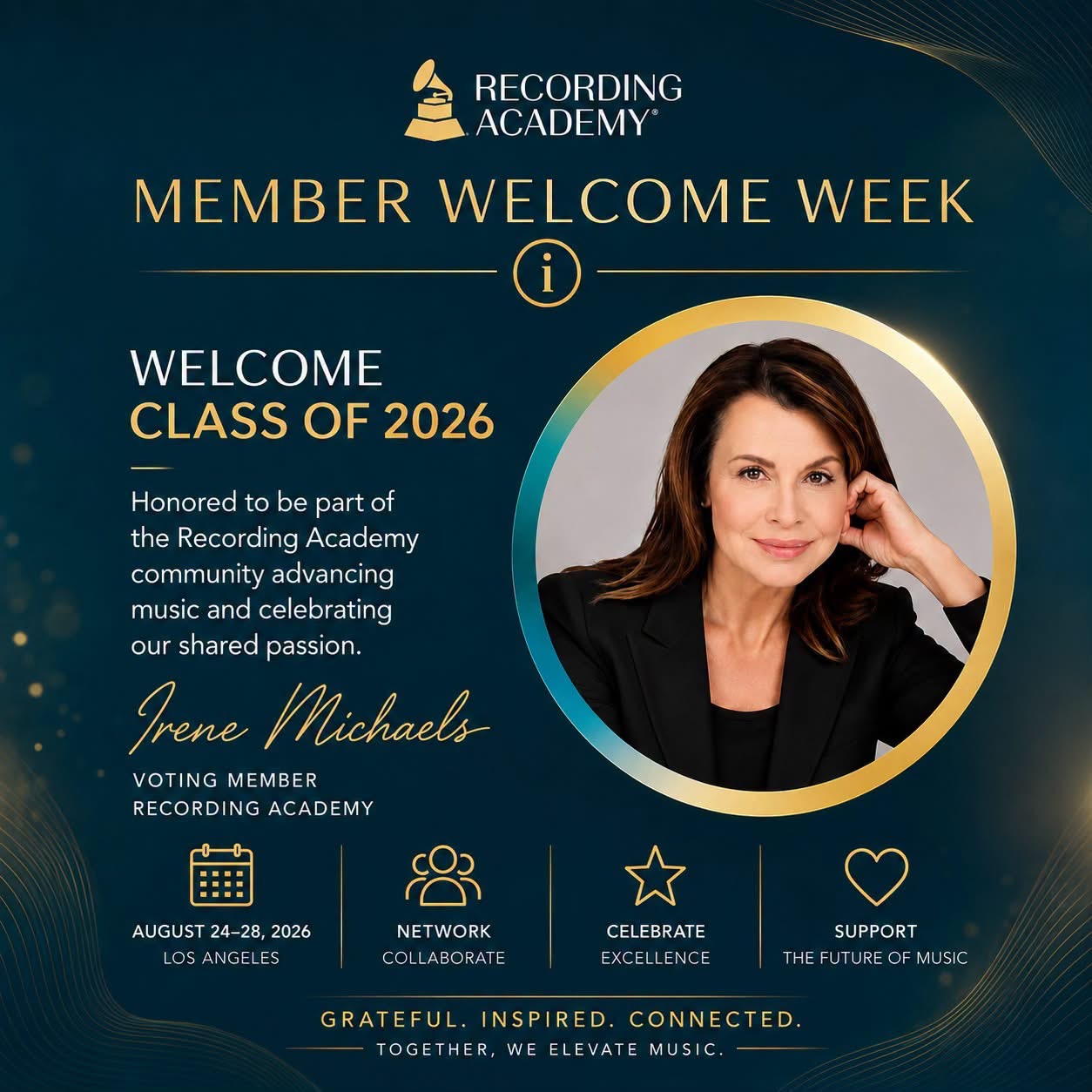
Awards nominations tell an audience an artist’s work has been noticed. Recording Academy Voting Membership tells a different story: that the artist has been recognized as a peer within the industry itself. Irene Michaels was recently named a Voting Member of the Recording Academy — the organization behind the Grammy Awards — and the distinction carries weight well beyond a title on a bio page.
Voting Membership isn’t handed out casually. It’s reserved for performers, songwriters, producers, engineers, and other creators actively working in the recording industry, and it comes with real influence: Voting Members are the people who ultimately determine Grammy nominees and winners each year. For an artist to be recognized at that level is, in effect, the industry saying her work belongs in the same conversation as the artists and professionals shaping the awards themselves.

That’s a meaningful marker for Michaels’ ongoing music career, which has moved from EPs and singles to Josie Music Award recognition and now into this kind of institutional standing. It reframes her not just as an artist building a catalog, but as a working member of the community that evaluates and honors that catalog industry-wide — someone whose judgment on music now carries an official vote.
It also adds context to everything else happening in her 2026: a triple nomination at the 12th Annual Josie Music Awards, an EP in Golden that’s earning recognition on its own merits, and a career that has spent the last several years steadily building credibility as a serious recording artist rather than a novelty comeback story. Recording Academy membership doesn’t arrive for artists still proving themselves — it arrives for artists the industry has already decided are part of it.
For Irene Michaels, whose career has spanned modeling, acting, publishing, and now music across multiple decades, the Recording Academy recognition is less a single headline than another data point in a larger pattern: an artist whose reinvention keeps being met, at every stage, with the industry taking her seriously.
-

 We Speak Music1 week ago
Moon Rocket Finds the Space Between Soul and Dancefloor on ‘Just Us Alone’
-

 We Speak Music1 week ago
The Songs of Butler & Cupples Share New Single ‘Therapy’
-

 We Speak Hip-Hop1 week ago
Hieroglyphics drop new LP & video
-

 We Speak Music1 week ago
Slay Raché Shines In New Single “You Make Me Wanna Dance”