
We Speak Music
NoteSpeak (In a Word) Arrives as the Trilogy’s Most Ambitious Statement

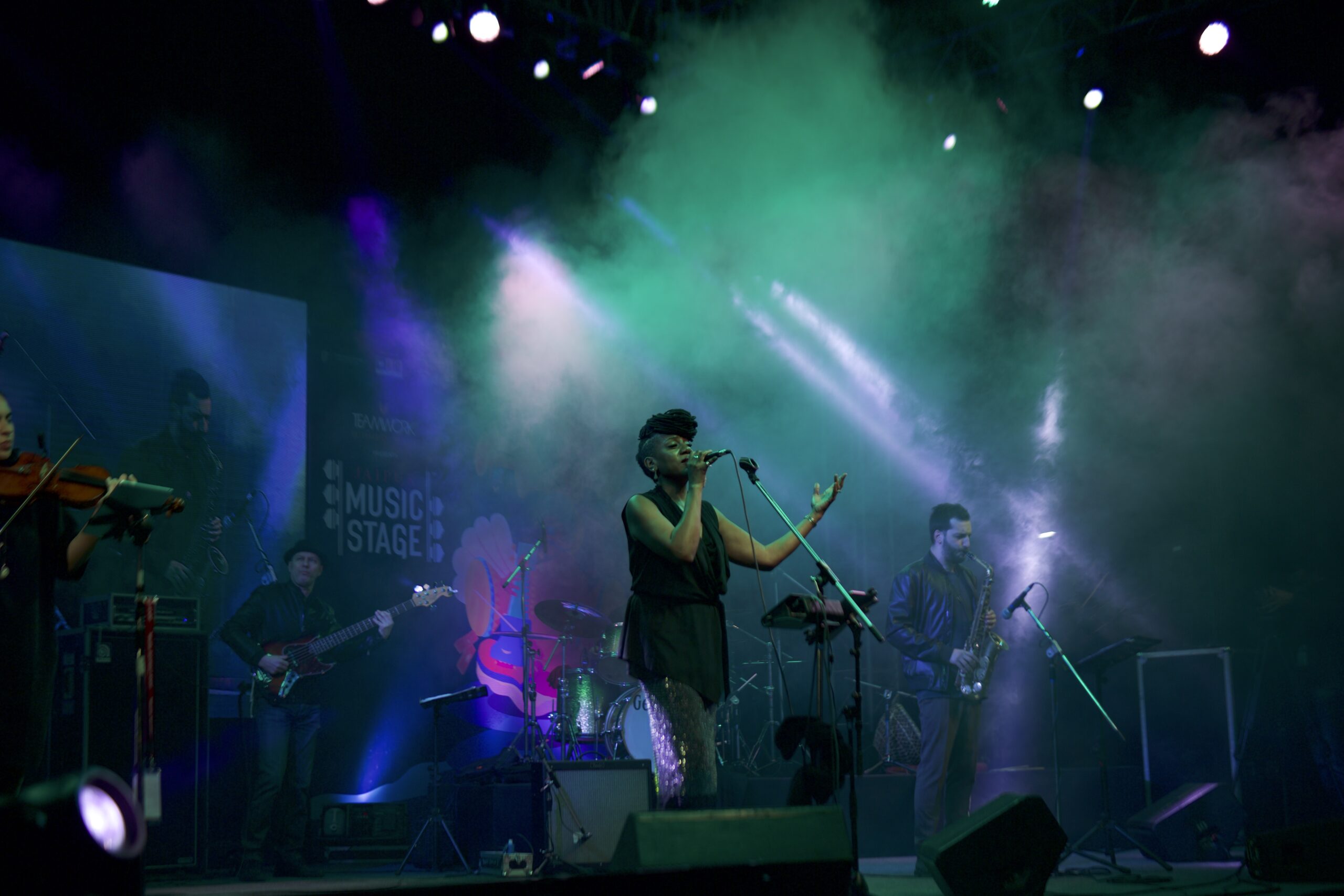
Lisa Marie Simmons and Marco Cremaschini have spent the better part of a decade building toward this moment. Their third album under the NoteSpeak banner lands as something fully formed, a record that moves between jazz, spoken word, electronica, and hip hop with the ease of artists who’ve spent years learning how to talk to each other across those genre lines.
Simmons came up writing and performing in New York before settling in Italy. Cremaschini brings a deep European jazz vocabulary. Together they’ve created what’s being called a global jazz hybrid, though that term barely covers the ground. What actually happens across these thirteen tracks is messier and more alive than any clean descriptor. The music flexes from interior moments to passages that arrive with real heat. The words carry both the personal and political weight equally. It’s the kind of record that assumes you’re paying attention.
The album opens with Christof Bernhard’s gong work on “Intro” and immediately signals that this isn’t going to sit still. Gillian Margot, the Toronto vocalist who’s shared stages with Sting and Robert Glasper, takes the lead on “Once Upon This Time”. Jamaaladeen Tacuma, whose bass work has been foundational to avant-garde jazz since his Prime Time days with Ornette Coleman, appears on “Taijitu” alongside Maurizio Giannone and Chanele McGuinness. Vernon Reid of Living Colour brings his unmistakable presence to bookend tracks. Charu Suri, Grammy nominated and the first Indian-born jazz composer to perform at Carnegie Hall, adds something subtle but essential to “Winner Takes All”. Dorian and Nayanna Holley duet on “No Time at All”.
What catches you is “Solid Ground (Meet Me There)” featuring The Flamingos’ Theresa Trigg and Terry Isaiah Johnson. Johnson, a Rock and Roll Hall of Famer who arranged the Flamingos’ “I Only Have Eyes for You,” died on October 8, 2025, twelve days after this album’s release. This is one of his final recordings. It carries weight now that it didn’t before.
The working band is sharp: Simmons anchoring everything, Cremaschini on piano and keyboards, Manuel Caliumi splitting time between alto saxophone and bass clarinet, Marco Cocconi holding down electric bass, Federico Negri on drums. Laura Masotto brings violin to “Submersion”. The tightness you hear is earned. These musicians know how to listen to each other.
This is the third in the NoteSpeak trilogy on Ropeadope Records. The first, “NoteSpeak (Amori e Tragedie in Musica),” landed in 2020. “NoteSpeak 12” arrived in 2023 and won Best Spoken Word Album at the World Entertainment Awards. Simmons’ poem “Last Supper” from that record picked up a Creators of Justice Literary Award shortlist. Now the third installment keeps building. Individual tracks are already placing as finalists in the John Lennon Songwriting Contest and semi-finalists in the American Songwriters Song Contest.
DownBeat gave the first album four stars. The second earned five, with J. Poet noting how Simmons moves between singing and speaking with such fluidity that the distance between poetry and music essentially evaporates. DownBeat named it one of their Best Albums of 2023. All About Jazz gave it four stars, with Chris May positioning it as equal-measure top-end poetry and top-end jazz. In a piece that got widely shared, Chris Slawecki traced the lineage back through Ishmael Reed and forward through Queen Latifah, which is the kind of considered frame you rarely see.
The reference points are legion: Nina Simone, Gil Scott-Heron, Fela Kuti, John and Alice Coltrane, Thelonious Monk, Miles Davis, Billie Holiday, Marvin Gaye, Maya Angelou, Sonia Sanchez, Angela Davis, Toni Morrison, James Baldwin, Audre Lorde. Then separately: Joni Mitchell, Joan Baez, Bob Dylan, Ani DiFranco. And running through contemporary music: Robert Glasper, Esperanza Spalding, Vijay Iyer, Rhiannon Giddens, Anderson Paak.





There’s something wonderfully provocative about writing a song about God and then dressing it in the musical equivalent of black leather, shadowy nightclubs and the occasional reference to 666.
On ‘Take It or Leave It’, London-based artist Alysha challenges the assumption that spirituality and alternative music belong in separate worlds, delivering a brooding collision of gothic electronics, new-wave tension and unapologetic self-expression.
It’s an intriguing contradiction, but one that makes considerably more sense when you consider the artist behind it. Raised on everything from church gospel and Lauryn Hill to Siouxsie & The Banshees, Alysha has never had much reason to believe that musical identity should be confined to one particular sound. Here, those seemingly opposing influences finally find a shared language.
Co-produced alongside Matt Rist, ‘Take It or Leave It’ replaces the familiar warmth of gospel with shadowy synths, electronic textures and a distinctly nocturnal atmosphere. There’s a hypnotic quality to the production, allowing gothic tension to sit comfortably alongside Alysha’s melodic instincts without sacrificing the track’s accessibility.
The most interesting element, however, isn’t simply the contrast between its sound and subject matter. It’s the way Alysha uses that contrast to question the expectations surrounding both.
Faith is often associated with a particular musical vocabulary, while gothic and alternative culture are frequently positioned as its natural opposition. Alysha appears considerably less interested in maintaining that distinction. Her decision to reference 666, a symbol traditionally associated with everything her song ostensibly celebrates the opposite of, feels deliberately mischievous.
Yet beneath the provocation, the message remains remarkably straightforward. As Alysha herself explains, it’s an alternative song about God. No elaborate justification, no attempt to soften the darker aesthetics, and certainly no suggestion that spirituality must sound a particular way to be sincere.
That confidence extends to the track’s exploration of personal boundaries. Even its title, ‘Take It or Leave It’, suggests an artist increasingly comfortable presenting herself without negotiation. Listeners are welcome to embrace the contradictions, but she isn’t particularly concerned with resolving them on anybody else’s behalf.
It’s a fitting direction for an artist whose career has already moved through R&B, alternative pop and electronic experimentation. Rather than abandoning her earlier influences, Alysha seems to be finding increasingly unexpected ways for them to coexist.
That evolution also arrives at an important moment. With October bringing her biggest live appearances yet, supporting LANY across three stadium dates in Japan and another in South Korea, Alysha is preparing to introduce her music to considerably larger audiences. Interestingly, that expanding platform hasn’t encouraged her to become more conventional. If anything, ‘Take It or Leave It’ suggests the opposite.
Ultimately, the single’s most compelling rebellion isn’t its gothic production or provocative symbolism. It’s Alysha’s refusal to accept that faith, femininity and alternative identity must exist within somebody else’s expectations.
There are plenty of artists making dark electronic music, and plenty writing about spirituality. Alysha’s achievement is making the combination feel less like a contradiction than an entirely natural expression of who she is.
After all, if faith is supposed to be personal, perhaps the music expressing it should be too.
-

 We Speak Business1 week ago
Funl Raises $2.5 Million at a $10 Million Post-Money Valuation to Transform How Creators Bring Events to Life
-

 We Speak Entertainment1 week ago
ANGELICA FIGUEROA TAKES CENTER STAGE ON THE ANDREW EBORN SHOW ON OCTOPUS TV
-

 We Speak Events1 week ago
AI FILMFEST Calls for Entries
-

 We Speak Music4 days ago
National Gospel Recording Artist Ellen Hayes Announces the Release of Her Farewell Album, Behind My Eyes