
We Speak Business
From the Frontlines to the Screen: How West Texas Hospitals Became National Models of Crisis Leadership


In the vast and often unforgiving expanse of West Texas, healthcare doesn’t come easy. Resources are stretched, patients are sometimes hours away from care, and trauma doesn’t wait for convenience. Yet, against the odds, two hospitals—Medical Center Hospital in Odessa and Pecos County Memorial Hospital in Fort Stockton—are quietly transforming what it means to lead in rural emergency medicine. Their work, now drawing national attention thanks to the Amazon Prime docuseries Desert Doc, is setting a new benchmark in crisis leadership and trauma care.

What makes these institutions exceptional isn’t just their location or their patient volume—it’s their unwavering ability to deliver high-stakes medical care with limited resources, tight budgets, and enormous responsibility. In this region, where oil rigs outnumber ambulances and car crashes are all too common, fast, effective emergency response can mean the difference between life and death.
What’s behind their success? It’s a powerful blend of visionary leadership, courageous medical direction, and a culture built on resilience and adaptability. Leading the way are CEOs Russell Tippin of Medical Center Hospital and Betsy Briscoe of Pecos County Memorial Hospital—trailblazers who have pushed the boundaries of innovation in rural healthcare. Partnering with them are dedicated physicians like Dr. Sudip Bose, whose frontline experience as an US Army combat physician in Iraq shapes his calm, decisive approach to crisis care. As seen in Desert Doc, Dr. Bose is part of a committed network of clinicians who view rural emergency medicine not just as a career, but as a calling.

While the show Desert Doc brings these high-pressure moments to life on screen, what it also reveals is the remarkable strength of the systems behind the scenes. Pecos County Memorial Hospital, for instance, may be smaller in scale, but its impact is no less profound. Their medical staff routinely stabilize and save patients in conditions that would challenge even the best-equipped urban centers. Their coordination with air medical services, cross-training of rural clinicians, and integration of battlefield-inspired trauma techniques demonstrate a playbook that larger hospitals could learn from.
The pandemic further spotlighted these hospitals’ leadership under pressure. Medical Center Hospital quickly adapted to shifting protocols, staff shortages, and overwhelming patient volumes. Their response earned praise from both state and federal health authorities, showing that rural facilities can be agile and innovative in ways that larger systems often struggle to match.

The growing interest in Desert Doc isn’t just about entertainment—it’s a window into the reality of rural healthcare, and the hospitals and people rising to meet that reality every day. While the series centers on Dr. Bose’s gripping, real-time cases, the true story is broader. It’s about a region’s commitment to resilience. It’s about hospitals doing more with less—and doing it with excellence.
As the spotlight shines on these stories, one thing becomes clear: West Texas hospitals are no longer just local lifelines. They are national models of what’s possible when leadership, courage, and innovation collide.
🎥 Watch the Trailer: Desert Doc Trailer – YouTube
📺 Stream the Full Series on Amazon Prime: Desert Doc on Amazon Prime




We Speak Business
The Ecosystem Effect: Why People Are Beginning to Pay Attention to What Jertaker Is Building

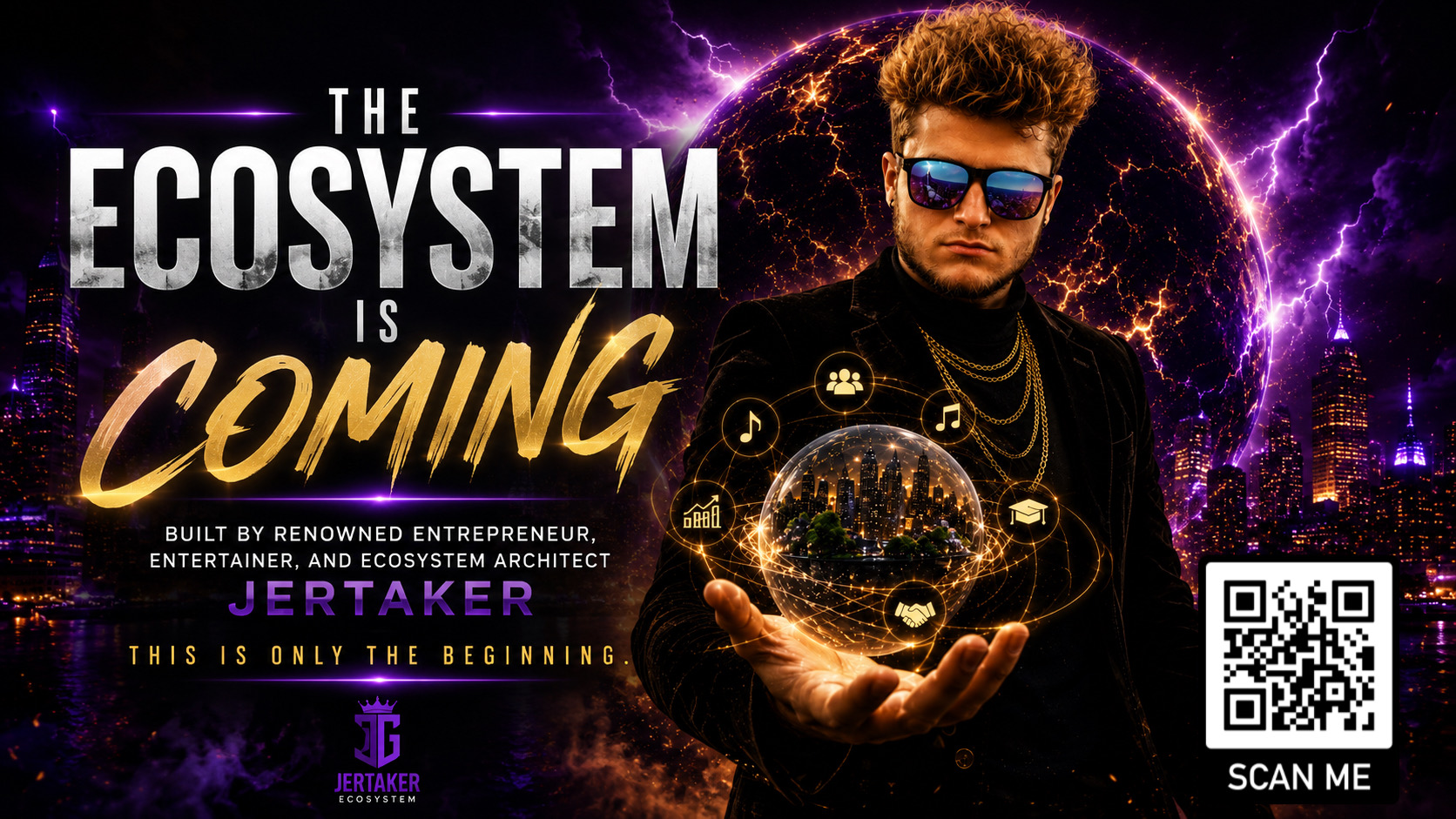
In a world where most people focus on building a single brand, business, or platform, entrepreneur, entertainer, systems architect, and innovator Jertaker has been quietly pursuing something much bigger.
For some time now, he has subtly referenced it in conversations, content, interviews, and discussions about the future. While many viewed those comments as ideas, ambitions, or long-term goals, those closest to the project know something different.
Behind the scenes, Jertaker has been aggressively working to turn those concepts into reality.
What started as a collection of ideas has evolved into a rapidly developing vision that continues to gain momentum with each passing month. Rather than creating one company, one project, or one audience, Jertaker is building an ecosystem.

At first glance, the concept sounds straightforward. Create value. Build communities. Connect opportunities. Develop systems that help people grow. But beneath the surface lies a much larger vision.
The ecosystem currently being developed is built around a powerful principle: everything should strengthen everything else. Instead of isolated projects competing for attention, the goal is to create an interconnected environment where education, entertainment, entrepreneurship, leadership, innovation, personal development, and collaboration naturally support one another.
As new pieces are added, the entire system becomes stronger. As new relationships are formed, new opportunities emerge. As new communities grow, additional value can be created for everyone involved. The vision is not centered around one product. It is not centered around one platform. It is not centered around one industry. The vision is centered around people.
People looking to grow.
People looking to learn. People looking to connect.
People looking to create something greater for themselves, their families, and their future.
Those closest to the project describe it as a living ecosystem—one designed to evolve, expand, and adapt over time. Rather than being confined to a fixed blueprint, it is intentionally being built to grow alongside the people it serves. That flexibility is part of the design. New opportunities can be integrated.
New ventures can be connected.
New communities can be welcomed.
New ideas can be developed.
And as each new piece is added, the ecosystem becomes more valuable than the sum of its individual parts.
What makes the project particularly interesting is not only the vision itself, but the pace at which it is progressing. Over the past year, there has been significant progress behind the scenes. What once existed primarily as concepts, sketches, conversations, and strategic planning has steadily transformed into tangible infrastructure and working foundations.
According to sources familiar with the project, the progress has been far greater than most people realize. While Jertaker has occasionally hinted at the ecosystem publicly, much of the development work has taken place away from the spotlight. The focus has never been on making the loudest announcement. The focus has been on building. And building. And building some more.
That commitment to execution is beginning to create momentum. Although the complete vision remains years in the making, there are growing indications that the public may soon begin experiencing the first stages of what is being created.
Not the final version.
Not the finished product.
Not the fully realized ecosystem. But the foundation. The first working layer. The beginning of something designed to continuously evolve over time. Supporters and observers should not expect a project that launches once and remains the same. The ecosystem is being designed with growth in mind.
Each stage is intended to create opportunities for future stages. Each improvement is intended to strengthen the next improvement. Each success is intended to create new possibilities.
In many ways, the project resembles a living organism more than a traditional business venture. It is designed to learn, adapt, expand, and become more impactful as it grows.
Known throughout various areas of entertainment, entrepreneurship, media, and business development, Jertaker has earned a reputation as a visionary thinker capable of seeing connections where others see separation. His approach combines creativity, innovation, systems thinking, and long-term strategic planning to build frameworks capable of expanding far beyond their original scope.
Many people build businesses.
Many people build brands.
Many people build audiences.
Few attempt to build ecosystems.
That distinction is becoming increasingly important.
Because while the public may only be seeing glimpses of the vision today, those involved understand that the long-term objective extends far beyond what currently exists. The goal is not simply to launch another brand. The goal is to create an environment where opportunity compounds. Where value creates more value. Where relationships create more relationships. Where growth creates more growth.
And while no one can predict exactly what the ecosystem will look like years from now, one thing appears increasingly certain:
This is only the beginning. The foundation is being laid. The vision is taking shape. The momentum is growing.
And if the trajectory continues, the ecosystem Jertaker has been quietly discussing for years may soon become something people can finally experience for themselves. Not because someone told them about it. But because they become part of it.

-

 We Speak Music1 week ago
Moon Rocket Finds the Space Between Soul and Dancefloor on ‘Just Us Alone’
-

 We Speak Music1 week ago
The Songs of Butler & Cupples Share New Single ‘Therapy’
-

 We Speak Hip-Hop1 week ago
Hieroglyphics drop new LP & video
-

 We Speak Music1 week ago
Slay Raché Shines In New Single “You Make Me Wanna Dance”