
We Speak Indie Artist
For Your Consideration: Timeless Voices and Future Visions at the GRAMMY® Awards


For your consideration at the GRAMMY® Awards: Randy Edelman brings two entries that showcase the breadth of his craft—21 Again/Coming of Age in Pop Solo Performance, and the beautifully sculpted Pat Wants To Know in Arrangement, Instruments and Vocals—proof that elegance and emotional clarity can still stop time. Irene Michaels, joined by Twizm Whyte Piece, lights up Dance/Electronic Recording with My Heart, a pulse-driven track that marries sophistication with sheer lift.
Siphia steps boldly into Dance/Electronic Recording with Paradise Now, a future-facing anthem where human storytelling and cutting-edge production meet in a single, surging breath. Chris Pati’s Shine A Light enters Arrangement, Instruments and Vocals with luminous writing that lets every line sing and every instrument speak.

Quinn Lemley’s Rita Hayworth Revealed celebrates the golden era while sounding vibrantly present—submitted for Jazz Vocal Album and Large Jazz Ensemble Album, with a spotlight Jazz Performance for That’s All and a gleaming Arrangement, Instruments and Vocals entry for Blue Pacific Blues (arrangements by Tedd Firth and Tom Wilson). Rachael Cain and the iconic Trax Records submit for Album of the Year—a historic banner for the house-music lineage that reshaped global dance culture and still drives the heartbeat of modern pop.
These submissions span legends and innovators, torch songs and neon beats, intimate arrangements and widescreen vision—artists united by craft, courage, and songs that stay with you long after the last note fades. For your consideration.
More from We Speak Media:
- Cut The Cord. Release Debut EP ‘blush.’ And Share The Title-Track Video
- FENIX360 Ignites the Triad Theatre with an Electrifying Night of Music, Talent, and Artistic Freedom
 Avohee Avoher’s “Elorian” Turns Virtuosity Into Something Deeply Human
 ‘Visions of Optimism’: Supreme Da Almighty Brings a Fresh Perspective to Hip-Hop
 Lili Caseley, Fabe Da Don and Esosa Gabrielle Continue Their Radio Momentum with Another Week on The Indy Hook Up
 PRYMRR BREAKS FREE WITH NEW SINGLE AND MUSIC VIDEO ‘SICK OF IT’
 Wuthering Waves Version 3.8 ‘Lilies in a Dying Dream’ Brings Lily, a New Main Quest and More on November 12
 Gear Up Einstein! Drafts History’s Biggest Names Into Early Access on Steam
 ATMOSFAR Lifts Off Into Steam Early Access With Co-op Survival Among the Clouds
 Starsand Island Sets Its Steam Early Access Course for February 1




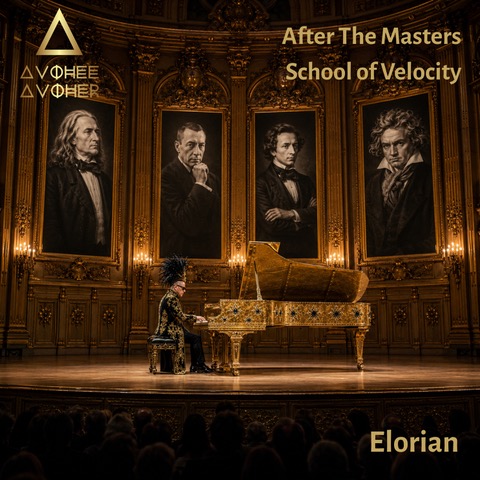
Every so often a piece of piano music arrives that refuses to sit still in one century. Avohee Avoher’s “Elorian,” the newest chapter of his ambitious After the Masters – School of Velocity project, is exactly that kind of work. It carries the fire and fingerwork of the great Romantic keyboard tradition, yet it speaks in a voice that is unmistakably of this moment, and unmistakably his own.
Avoher has never been content to simply admire the masters from a respectful distance. His earlier explorations, including the 12V piano cycle, Avohee Meets Bach, and the recent two-piano adventure “Calune,” have shown a composer who studies the giants closely and then asks what they might spark in a contemporary imagination. “Elorian” pushes that conversation further. The spirit of Franz Liszt and Sergei Rachmaninoff hovers over the piece, but Avoher is not interested in costume drama. He borrows their daring, not their wardrobe.
The composition opens softly, almost hesitantly, as though the music is deciding whether to reveal itself. Delicate melodic threads appear, wind around one another, and slowly gather momentum until they bloom into broad, sweeping passages that put Avoher’s formidable technique on full display. It is thrilling to hear, but the dazzle is never the destination. Just when the piece seems ready to overwhelm, it pulls back into a hush, and those quiet stretches are where “Elorian” truly lives.
That push and pull between power and tenderness is the heartbeat of the work. Avoher treats speed and precision as tools for storytelling rather than proof of skill, and the result is music that feels emotionally specific even without a single word. There is longing in it, and hope, and a kind of unresolved searching that lingers after the final notes fade.

The title itself is part of the invitation. “Elorian” is an invented word with no fixed meaning, and Avoher deliberately leaves it open. One listener may hear a love story, another a farewell, another a quiet act of discovery. Rather than steering the audience toward a single interpretation, he hands them the key and lets them choose the door, a generous gesture that makes the piece feel personal to whoever is listening.
The official music video, which Avoher conceived and produced himself, carries that same openness into the visual realm. Rolling landscapes, moving water, and dreamlike images of human tenderness drift across the screen without forcing a plot onto the music. The visuals breathe alongside the piano instead of explaining it, and the pairing makes for an absorbing, almost meditative experience.
Sonically, “Elorian” is a jewel. The track was mastered at London’s storied Abbey Road Studios by Stefan Brown, and the care shows. In a piece where so much depends on the smallest shifts in touch, color, and dynamics, every whispered phrase and every thunderous run comes through with clarity and warmth. Nothing is lost, and nothing is overstated.
What makes Avohee Avoher such a compelling figure in contemporary classical music is his refusal to choose between reverence and reinvention. He honors the tradition by taking it seriously enough to challenge it, and “Elorian” is the strongest evidence yet of where that philosophy can lead. This is virtuoso piano music with an open heart, and it deserves to be heard by anyone who believes the instrument still has new stories to tell.
Stream Elorian by Avohee Avoher on Spotify here:
EXPERIENCE “ELORIAN”
Watch on Avohee Avoher’s YouTube:
https://youtu.be/TgEMrVrVcOo
Read Next
- “Visions of Optimism”: Supreme Da Almighty Brings a Fresh Perspective to Hip-Hop
- Lili Caseley, Fabe Da Don and Esosa Gabrielle Continue Their Radio Momentum with Another Week on The Indy Hook Up
- PRYMRR BREAKS FREE WITH NEW SINGLE AND MUSIC VIDEO “SICK OF IT”
‘Visions of Optimism’: Supreme Da Almighty Brings a Fresh Perspective to Hip-HopLili Caseley, Fabe Da Don and Esosa Gabrielle Continue Their Radio Momentum with Another Week on The Indy Hook UpPRYMRR BREAKS FREE WITH NEW SINGLE AND MUSIC VIDEO ‘SICK OF IT’ Catie Turner Releases Existential Pop Anthem and Mod Fashion-Inspired Music Video “Who Am I?”Wuthering Waves Version 3.8 ‘Lilies in a Dying Dream’ Brings Lily, a New Main Quest and More on November 12Gear Up Einstein! Drafts History’s Biggest Names Into Early Access on SteamATMOSFAR Lifts Off Into Steam Early Access With Co-op Survival Among the CloudsStarsand Island Sets Its Steam Early Access Course for February 1
-

 We Speak Beauty1 week ago
KAYALI Bottles a Birthday With Yum Vanilla Cupcake | 108
-

 We Speak Gaming1 week ago
Hot Dogs, Horseshoes & Hand Grenades 2 Launches Soon on Quest 3
-

 We Speak Beauty1 week ago
Dyson Debuts Airsmooth, Its First Dedicated Dryer Brush, for $249.99
-

 We Speak Rap1 week ago
Don Toliver Earns His First Hot R&B/Hip-Hop Songs No. 1 With Drake’s “Solar Eclipse”