
We Speak Folk
Interview with indie-folk newcomer Samuel Taylor


We’re joined by Samuel Taylor, a 23-year-old indie-folk newcomer from Suffolk whose debut single “Little World” has just been released on No Roads Records. With a sound shaped by his countryside upbringing and inspired by artists like Bear’s Den and Johnny Flynn, Samuel’s music blends delicate acoustic textures with heartfelt storytelling. His first release has already been described as cinematic, transportive, and deeply moving.
- You grew up in the Suffolk countryside, swimming in rivers and cycling in forests. How do you think that isolation and natural setting shaped your songwriting?
Living in the middle of nowhere has its pros and cons, I suppose. I wasn’t in a band, so I didn’t have people to experiment musically with, but that also meant I could find my own music and create something a little different, maybe. I often write in the garden, it gives me the space to think. If I get writer’s block, I go for a walk in the fields.
- You first learned banjo by ear from your dad’s old bluegrass records, what drew you to
that sound before guitar and indie-folk entered your world?
My mum and dad tell me this story about how, 30 years ago, they were looking in the window of a charity shop at two things for sale – a banjo and an 80s Moog synthesiser. They chose the banjo, so I guess my fate was sealed then. My dad didn’t learn it in the end. He likes to say he taught me everything he knows, but he leaves out that that took him 5 minutes.
- Was there a particular moment when you realised music was the path you wanted to
follow?
I had a really cool music teacher who spotted early on that I was obsessed with music and guided me all the way through school – what else would you do with a 10 year old who turns up in your class with a banjo? In sixth form, he suggested I listen to Bears Den. There was a whole year where all I listened to was their Islands album. Then I went to see them at Shepherds Bush in London, and suddenly I was in a room full of people like me. I knew then it’s what I wanted to do. My mum suggested I give music a go, so I applied to do a contemporary music degree.
- People have compared your sound to Nick Drake, Sufjan Stevens, and early Ben Howard but also say your voice is unlike anyone else’s. How do you see your influences fitting into your own sound?
Bear’s Den are still my biggest influence. I loved the intimate songwriting. It moved something in me and made me want to write my own music. But then I also discovered my mum’s old vinyl collection, and got into Paul Hardcastle and Gary Numan, which is probably why Little World is littered with Moog synthesisers. Maybe my mum and dad should have bought that one in that shop?
- Do you think the “indie-folk” label captures what you’re trying to create, or do you see
your music as something else?
I don’t set out to write within in a genre but people describe it as ‘indie folk’ and some of my favourite artists – Bear’s Den, Johnny Flynn, and Laura Marling – are indie folk, so it’s how I found my music. I love the honest and pure nature of folk, but it’s important for me to have other influences woven in. So the indie folk label is fine with me – if they’ll have me!
- You’ve described your new song “Little World” as a song about loving someone with
fragility and navigating that in a relationship. Was it difficult to write something so
personal?
Little World is more about a feeling than one particular person. I think we’ve all got a version of fragility in someone we know, or even ourselves. It’s about finding peace in that process. I write music for myself, and these things come out when you are most frustrated.
The line “I’m tired of trying for you” is about those times. It’s a song about revealing the parts of ourselves we think others won’t accept. And the hope of when they do, and you feel safe.
- What do you hope listeners feel or take away when they hear “Little World” for the first
time?
It’s a song about overcoming difficulty – about being optimistic even in the toughest moments. I hope people take Little World in the context of their own experiences.
I like it when people tell me that Little World relates to something in their life. It’s never the same circumstance but always the same feeling.
- Signing with No Roads Records must have been a big moment! How did it feel when Jesse Quin signed you on the spot?
I had just finished my degree and moved home to Suffolk. I wanted to do something with music, and heard about this local producer Jesse and his studio at Old Jet so I asked him for coffee. He mentioned he was off to Mexico soon, I said, ‘on holiday’? And he was like, ‘no, with my band’. That’s when I realised he was in Keane. But what matters is that Jesse’s as big of a musical nerd as me. When I played him some tracks that day, we spent the next half an hour running around his studio, looking at obscure instruments and synths he thought would work on them – from that moment I knew they were in safe hands.
- At just 23, you’re at the very start of your career. Where do you hope to take your “little
world” of songs in the next few years?
I’m looking forward to starting to play these songs live this autumn, then releasing my EP in January. Hopefully with more exciting stuff to come next year!




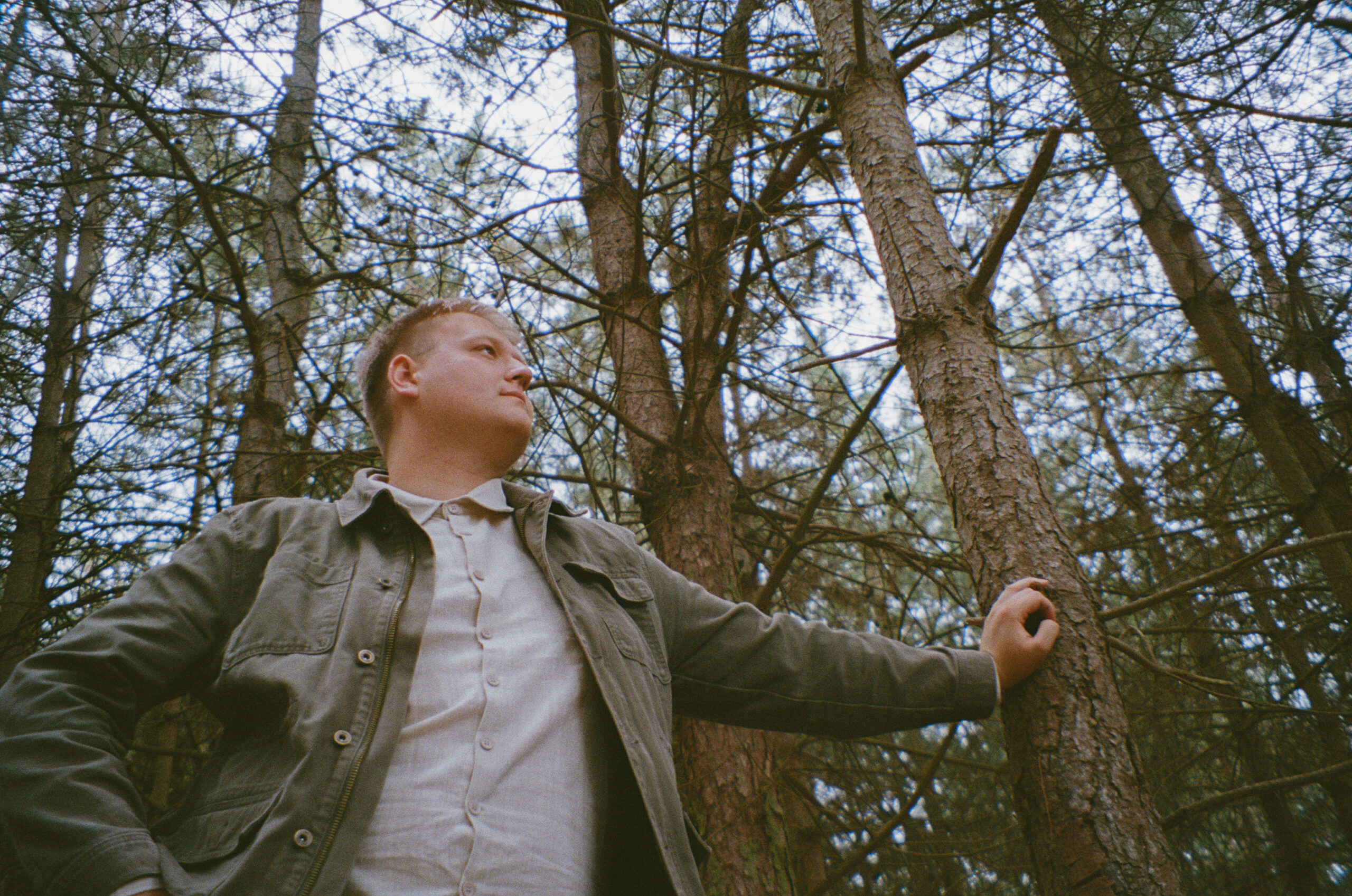
There is something quietly magical about discovering an artist at the very beginning of their journey, and Suffolk songwriter Samuel Taylor feels exactly like that kind of moment. His debut EP Lost & Overgrown, released via No Roads Records, is a beautifully intimate introduction to his world.
At just 23, Samuel writes with the kind of emotional depth that usually takes decades to find. Rooted in finger-picked acoustic guitar and gently unfolding arrangements, Lost & Overgrown is warm, reflective and quietly powerful. Produced and mixed by Jesse Quin of Keane and Mt. Desolation, the EP wraps Taylor’s fragile, emotionally attuned vocals in subtle layers of strings, keys, banjo and understated percussion. The result is immersive without ever feeling heavy, cinematic yet deeply personal.
The title track ‘Lost & Overgrown’ sets the tone perfectly. It explores the weight of early-life burdens and the way they shape how we love, communicate and protect ourselves. There is a tenderness to the songwriting, but also a sense of growth. As Samuel explains, it is about cutting back the overgrowth and starting again. It is reflective and honest, yet ultimately hopeful.
Across the EP, Taylor balances melancholy with reassurance. These are songs about longing, mental processes and the quiet resilience we carry even in our hardest moments. Raised in the Suffolk countryside, swimming in rivers and cycling through forests, his music carries that same sense of open space. You can almost feel the air between the notes. It is indie-folk that breathes.
Lost & Overgrown is the kind of debut that invites you to slow down and really listen. It is tender without being fragile, introspective without losing warmth, and quietly uplifting in a way that lingers long after the final note. If you are searching for music that feels like solace on a cold evening or a long walk through the countryside, Samuel Taylor might just be your new favourite discovery.
-

 We Speak Music1 week ago
Moon Rocket Finds the Space Between Soul and Dancefloor on ‘Just Us Alone’
-

 We Speak Music1 week ago
The Songs of Butler & Cupples Share New Single ‘Therapy’
-

 We Speak Hip-Hop1 week ago
Hieroglyphics drop new LP & video
-

 We Speak Music1 week ago
Slay Raché Shines In New Single “You Make Me Wanna Dance”